Wild licorice extract from the Ural River floodplain
Processing wild licorice root (Glycyrrhiza glabra) into block extract at our plant in West Kazakhstan. Direct supply to confectionery, tobacco, food and pharmaceutical manufacturers.
licorice from natural stands in the Ural River floodplain
≥18% GA
target content in paste and blocks · HPLC
3,000 t/year
design capacity for dry root processing
800 t/year
design capacity for extract powder production
Origin makes a difference
The value of wild licorice root
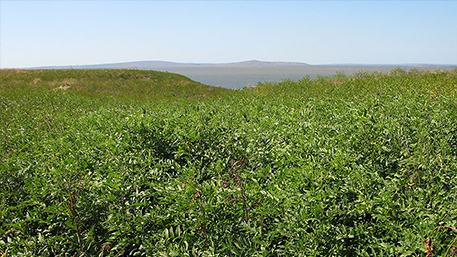
Our key advantage in the global market is wild licorice from the Ural River floodplain. We know where the root comes from and take care to preserve its natural value, from harvesting through to processing.
Uncultivated natural habitat
Naturally wild
Our licorice grows on uncultivated land, away from intensive farming. Pesticides and herbicides are not applied in our harvesting areas. We work with naturally occurring, non-genetically modified wild root.
The Ural region’s climate and soils
Shaped by its environment
The Ural region has a sharply continental climate, with cold winters and hot summers. Temperature swings and nutrient-poor saline soils create natural stress that can stimulate the synthesis of secondary metabolites: the root’s protective compounds.
Glycyrrhiza glabra
A valuable natural composition
Glycyrrhizin and flavonoids, including glabridin, contribute to the plant’s natural defences. We focus on root with a high glycyrrhizic acid content for extraction; the actual level is determined by HPLC analysis.
Responsible harvesting
Careful harvesting and regeneration
We plan harvesting around the condition of the natural stands. Careful root extraction and time for natural recovery help preserve licorice and the productivity of harvesting areas. This is our approach to responsible wild harvesting.
Sustainably wild-harvested
Careful harvesting with time for natural licorice stands to recover.
Pesticide-free habitat
Uncultivated growing areas with no pesticide or herbicide applications.
Non-GMO
Naturally occurring wild root, without genetic modification.
From wild root to your formulation
Our products
Wild licorice extracts in block, paste and powder form for confectionery, tobacco, food and pharmaceutical manufacturing. Glycyrrhizic acid content, packaging and supply terms are agreed with the buyer.
Target specifications are shown below. Production of blocks and paste is scheduled to start on 1 March 2027, followed by powder on 1 August 2027. Final specifications are agreed with the buyer.
Licorice block extract
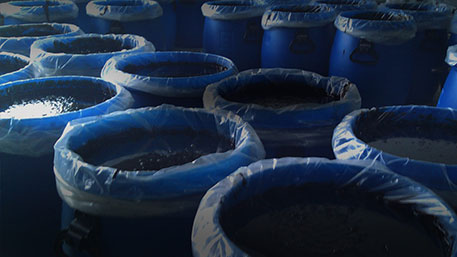
A solid, dark-brown extract with a characteristic sweet taste. For confectionery, tobacco and food manufacturing, as well as further processing. Blocks are packed in poly-lined cartons.
Extractum radicis Glycyrrhizae spissum. A thick, dark-brown mass with a faint characteristic odour and an intensely sweet taste. For production processes that require an extract in paste form.
Glycyrrhizic acid (HPLC)
18 % min.
Moisture
32–38 % (33 % on average)
Ash
4.5 % max.
Insoluble matter
0.5 % max.
Packaging
polyethylene Euro drums with a capacity of 48 L or more; net extract weight of at least 60 kg; alternative packaging on request
A dry extract standardised for glycyrrhizic acid content. Convenient for dosing and preparing solutions. We will agree on the required specifications for your formulation.
The QazLicorice plant is located in West Kazakhstan. The production cycle connects careful harvesting in the Ural River floodplain, wild root preparation and the manufacture of extracts to agreed specifications.
We know our root’s origin
We organise wild root harvesting on our own land and oversee selection and preparation for processing. This connects raw material quality to specific harvesting areas and allows the condition of the natural stands to guide our harvest planning.
Careful processing
Low-temperature countercurrent extraction and gentle concentration in scraped-surface vacuum evaporators support thorough recovery of active compounds while reducing thermal stress on the extract. Operating conditions are monitored through SCADA. The line is designed to process up to 3,000 tonnes of dry root per year.
Three stages of careful processing
The process combines thorough raw material preparation, efficient extraction of active compounds and gentle thermal treatment.
01 · Preparation
Multi-stage root preparation
Washing, drying and the removal of foreign matter prepare the root for extraction. Removing soil and sand helps reduce ash content and suspended mineral particles in the finished extract.
02 · Extraction
Low-temperature countercurrent diffusion
Opposing flows of root and extractant maintain a concentration gradient, supporting thorough extraction of active compounds at low temperatures. The extract is clarified by mechanical separation, without chemical clarifying agents.
03 · Concentration
Scraped-surface vacuum evaporation
Vacuum lowers the boiling temperature, while scrapers continuously renew the product layer at the heated surface. This limits local overheating and reduces the risk of caramelisation, helping preserve the extract’s natural characteristics.
Microbiological quality is addressed through raw material preparation and process hygiene, without harsh sterilisation. Ash content, insoluble matter and microbiological parameters are checked against the agreed specification.
Processing technology and production hygiene
construction and finishing materials suitable for food production;
stainless steel equipment;
reverse osmosis treatment of process water;
clarification of the extract with an Alfa Laval separator;
automated cleaning of equipment using a clean-in-place (CIP) system;
staff hygiene controls.
The value of our extract begins in the Ural region’s natural licorice stands. Our purpose is to preserve that value through harvesting and processing, creating a quality ingredient for your production.
Our principles
Responsibility to buyersTraceable root origin, agreed specifications and quality control for every batch.
Responsibility to our peopleSafe working conditions, skills development and respect for each employee’s contribution.
Responsibility to natureCareful harvesting, preservation of natural stands and time for their natural regeneration.
The Ural region’s heritage
A root with a history
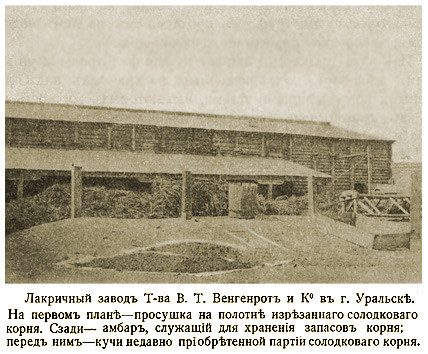
The V. T. Wengenroth & Co licorice plant in Uralsk. Cut licorice root is drying in the foreground.
The Ural River floodplain has long been known for its extensive licorice stands. Generations of local people gathered knowledge of its medicinal properties. The ancient Greeks, who obtained licorice from the Scythians for medicinal use, called it “Scythian root”.
In the 1890s, the enterprising pharmacist Pfeil established Uralsk’s first licorice root processing plant. He supplied cut and ground root, tinctures and decoctions to pharmacies across Russia and Central Asia.
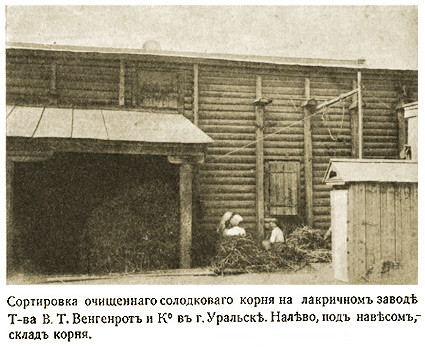
Sorting peeled licorice root at the V. T. Wengenroth & Co plant in Uralsk.
1916 · An account by the botanist Monteverde
“At present,” wrote the botanist Monteverde in 1916, “root is harvested along the steep banks of the Ural by residents of the Cossack settlements of Skvorkinskaya and Budarinskaya, and farther downstream as far as Kalmykovskaya. Local shopkeepers purchase the root for 1 rouble 50 kopecks. They take the purchased root to Uralsk, where there are two processing plants. The material used for processing consists of well-dried licorice roots, both unpeeled and peeled; the latter undergo further cleaning and sorting.”
QazLicorice carries forward the region’s tradition of working with wild licorice, bringing knowledge of local raw material together with modern processing technology.
Quality defined by specifications
Root origin and preparationIdentification of the botanical species and harvesting areas. Moisture and cleanliness checks, with inspection for mould and foreign matter.
Process controlExtraction and evaporation temperatures and durations are recorded in the batch log. Process conditions are monitored through SCADA.
Finished batch analysisGlycyrrhizic acid content is determined by HPLC. Moisture, ash, insoluble matter and microbiological parameters are also checked.
Buyer documentationA certificate of analysis (CoA) and specification are planned for each batch. The scope of additional testing, including testing for pesticide residues, and the arrangements for independent laboratory verification are agreed with the buyer.
Let’s discuss your extract requirements
A direct conversation with the manufacturer, from product specifications to supply terms.
QazLicorice LLP West Kazakhstan Region, Kazakhstan
Tell us the extract format, required glycyrrhizic acid content, volume and destination country. We will agree on specifications, packaging and delivery dates, and discuss sample availability. We reply within one business day.